
Camera inspection: $300–$750
The first and non-negotiable step. Most operators credit it against the works if you proceed.
A cracked or root-damaged drain does not have to mean a trench through the garden. A resin liner is cured inside the existing pipe from an access point you already have, sealing every joint along the run, and the surface above is never touched.
A resin-saturated liner is drawn into the existing pipe through an access point, inflated so it presses against the wall, and cured until it hardens. What you are left with is a continuous pipe inside the old one, with no joints along its length and a slightly smaller bore than the original.
Nothing is excavated, and the cured surface is smoother than the clay or concrete it lines, so flow is typically maintained or improved despite the small loss of diameter. On a property where a driveway, mature garden or paving sits over the line, that is the whole argument.
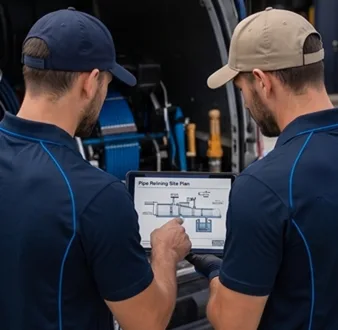

Water tracks along beams and slab falls, so the lot reporting the damage is often nowhere near the lot with the fault. Opening ceilings on a guess is how a small repair becomes three angry owners.
Camera and non-destructive location come first for exactly that reason. Once the defect is located and measured from a known point, the repair is a defined job and the liner goes in without exploratory demolition.
A listing does not stop you repairing a drain. What it restricts is change that is visible or that disturbs significant fabric, which is precisely what a trenchless repair avoids.
In practice that makes relining the path of least resistance on a listed or conservation-area property: nothing is removed, nothing changes above ground, and there is no reinstatement to get approved.
In a strip of tenancies the drainage is frequently shared, which means the fault is often not under the premises reporting it, and the party who pays is not always the party who called.
That is worth settling before the quote rather than after. Camera footage with distances marked from a known access point is what makes the conversation with a landlord or a neighbouring tenant short, because it shows exactly where the defect sits.
Where the water table sits close to the pipe, every open joint is an entry point. The line runs fuller than it should year-round, silt comes in with the water, and the system behaves as though it is undersized when it is simply leaking inward.
Runoff pours off the Domain and the Darlinghurst ridge into the suburb’s low streets during storms, surcharging drains on their way to the bay.
Sealing the run changes that immediately, and it is one of the clearest before-and-after results relining produces. It is also the case most often missed, because nothing looks broken from the surface.
Rows of terraces and converted apartments share tight common sewer runs, so one household’s wipes or grease can block an entire row’s line.
In a strata building the line between lot property and common property decides who pays, and it is worth settling before a quote rather than after. A branch serving your lot alone is generally yours; the stack it joins and anything in common property generally is not.
Relining changes the arithmetic here because it is usually cheaper than the alternative for a shared line, and because it can be done without opening ceilings in the lots below the fault. That tends to make the approval conversation shorter.
Excavation close to the foreshore brings problems that have nothing to do with plumbing: unstable saturated ground, dewatering, restricted access down a narrow lot, and reinstatement of landscaping that was not cheap to build.
The trenchless comparison is not repair against repair. It is repair against repair plus everything sitting on top, and on a waterfront block that second half is usually the bigger number.
The first and non-negotiable step. Most operators credit it against the works if you proceed.
Domestic sewer across Sydney in 2026. Longer single runs sit at the lower end of it.
Seals one defect. Right where the rest of the run is sound and the ground is stable.
Length, diameter and how many branches need reinstating are what move the number inside that band.
Excavation is only half the cost. Replacing the driveway or garden above it is the other half.
Indicative Sydney ranges for 2026. Your job is quoted in writing after the camera survey. Figures here are indicative of the 2026 Sydney market rather than a quote from us, you get your own number as a fixed price before any work starts.

Nothing is priced until a camera has been down the line. The survey is recorded, distances are marked from a known point, and the footage is yours.
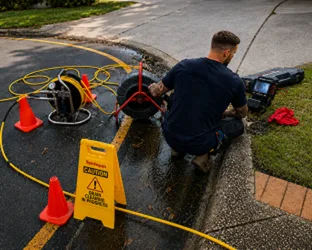
A single defect in a sound run wants a patch. A run failing along its length wants a full liner. A collapsed or sagging section wants excavation. The camera decides, not the quote.
Jet clean, install through the existing opening, cure in place. Water is off for part of the day and nothing above the pipe is disturbed.

Junctions reinstated, final camera run, and the compliance paperwork where the work is notifiable. You keep both recordings.
Describe what the drain is doing and how often. We will tell you whether it sounds structural or whether a clean and a maintenance interval is the honest answer.
Cost, lifespan, method, and the cases where a liner is the wrong answer.

Ring us or leave your details. You will get a time for the inspection, not a price invented over the phone.

Leave your details and our local Woolloomooloo team will call you back fast.